Chapter 8
Do You Express Your Core Emotions?
Researchers have identified two types of emotions: primary and secondary. A primary emotion is what you feel first, such as fear or embarrassment. A secondary emotion is one that masks it. For example, one may become embarrassed, but anger gets expressed instead. Couples who argue about the secondary emotions never focus on the real problem.
Introduction
The previous chapter was about finding the right word for what you feel. This chapter asks two harder questions. Where did that feeling come from, and is it the one you actually show your spouse?
In recent decades, social scientists have concluded that our emotions most often come from our thoughts. Consider a simple example. You expect your spouse home for dinner at 6:00. It’s 6:05, and from your bedroom you hear noises at the front door. You’re glad, because you believe your spouse is home. You head for the door smiling, arms open wide.
Now change one detail. The sounds and muffled voices at your front door come at 3:00 in the morning. You aren’t expecting anyone. Now you’re frightened, and you call 911. The noise is the same in both cases. What changed is what you thought the noise meant.
Many of us, when we want to imporve our marriages, focus on our emotions. We may tell ourselves, “I shouldn’t feel this way,” and then set to work suppressing whatever that emotion is. But a feeling pushed down doesn’t disappear; it waits, because the thought that produced it is still intact.
Marriage Principle 1: When uncomfortable feelings arrive, the answer isn’t to bury them or explain them away. It’s to examine the thoughts and interpretations of reality that give rise to them.
The subtitle of one international bestseller puts it this way: “Change How You Feel by Changing the Way You Think.”1 Psychiatrist Dr. David Burns, who has treated tens of thousands of patients without drugs, says much the same. Change how you think, he argues, and you can quickly change how you feel.2
First Your Thoughts, Then Your Emotions
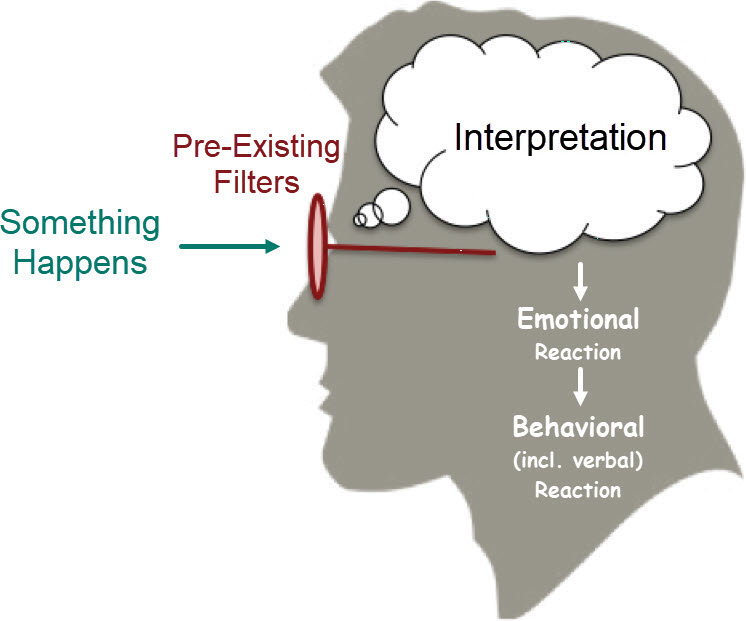
The Sequence
- Something happens or is said.
- It passes through your pre-existing filters before you have a chance to think about it.
- You interpret what happened. In marriage, your interpretation may be about yourself, your spouse, or the relationship.
- You react emotionally according to your interpretation. You may express that emotion, suppress it, or express a different, secondary emotion.
- You react outwardly to how you interpreted what happened and how you feel about it.
What a Filter Is
Nobody takes in an event cold. In marriage, for example, whatever happens arrives through everything you already believe: about yourself, about your spouse, and what happened the last time situation arose.
Filters are also why a small event can produce a large reaction. The reaction isn’t to the event. It is to the event plus the interpretation.
Two Things Can Go Wrong
Given how closely thoughts and feelings are tied together, it matters a great deal whether your interpretation is accurate. That is the first thing that can go wrong, and the two of you will work on it at the end of this chapter.
The second is easier to miss. Look again at step four above. An emotional reaction can be shown, hidden, or swapped for a different one, and which of those three happens decides what your spouse actually receives. That is the subject of the rest of this chapter.
What You Show May Not be What You Feel
From one thought, two emotions may emerge. There are primary emotions, also called core emotions, and there are secondary emotions. A primary emotion touches your feelings at your innermost being. A secondary emotion is the one you show instead.
Core emotions don’t always get expressed. A man thinks his wife is flirting with other men at a party. What he decides it means is that he doesn’t matter much to her. That interpretation leaves him feeling devalued and insecure, but he says nothing about it at the party, and he says nothing about it later at home. He explodes with anger instead, a secondary emotion sitting on top of the one he never named.
The argument that follows may send the two of them to separate rooms for the night. Notice what never got said out loud. Not his interpretation, that her attention to other men meant he didn’t matter much to her. And not the emotion that interpretation produced. His wife got his anger and nothing else. She can't respond to something she never heard.
The switch from a core emotion to a secondary one happens so fast that the man may not notice it. His wife has even less of an idea. She may conclude her husband has an anger problem when anger isn’t the underlying issue at all.
Marital Principle 2: Recognizing the difference between a primary and a secondary emotion can change how you interact with your spouse. If you can identify and share your innermost emotions, you will by necessity communicate your innermost thoughts as well. That’s when authentic communication happens and resolution to your ongoing problems becomes far more likely.
To Illustrate: The Same Cycle Every Time 3
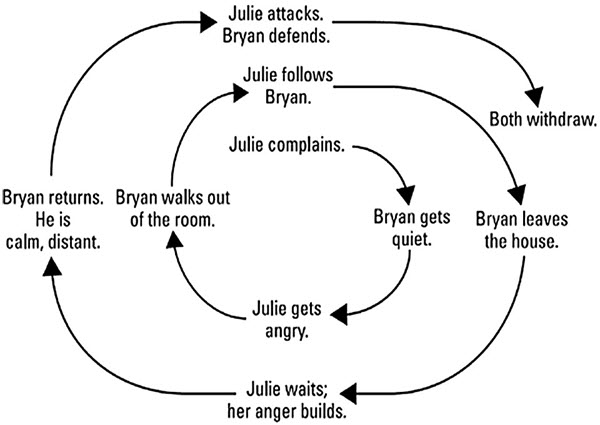
Consider Julie and Bryan. No matter what the conflict is, they engage in the same pattern.
The two scenarios below look at the first two actions of the cycle above, “Julie complains” and “Bryan gets quiet.” The second scenario shows how that pattern can change.
Scenario 1: Julie Does Not Share Her Core Emotion and Deepest Thought
Julie
1. Something happened. Julie is unhappy with Bryan. Instead of coming home after work, he usually hangs out with friends for a half hour.
2. Her interpretation. Julie sees a deeper meaning in what Bryan does. She thinks, “After all my efforts to make this marriage work, I am still not a priority to Bryan.”
3. Her emotions. Believing she isn’t Bryan’s highest priority makes her sad, and then mad.
4. Her reaction. Julie complains about how much time Bryan spends with his friends after work.
Bryan
1. Something happened. Bryan hears Julie’s complaint and thinks, “There she goes again. She never stops hounding me.”
2. His interpretation. He reads the complaint this way: “She always wants to control me.”
3. His emotions. That interpretation leaves him feeling beaten down and demoralized.
4. His reaction. Bryan gets quiet, because he has learned that arguing is pointless and draining and he just wants some peace.
The cycle continues.
Scenario 2: Julie Expresses Her Core Emotion and Deepest Thought
Julie
1. Something happened. Julie is unhappy with Bryan. Instead of coming home after work, he usually hangs out with friends for a half hour.
2. Her interpretation. Julie sees a deeper meaning in what Bryan does. She thinks, “After all my efforts to make this marriage work, I am still not a priority to Bryan.”
3. Her emotions. Believing she isn’t Bryan’s highest priority makes her sad, and then mad.
4. Her reaction. Julie says, “When you stay out after work, I end up feeling like I don’t matter to you. That hurts.”
A shift occurs. Julie now communicates her primary emotion instead of her secondary one, and the cycle is finally interrupted.
Bryan responds differently
1. Something happened. Bryan hears her and says to himself, “What does she mean she doesn’t matter to me?”
2. His interpretation. He is now confronted with Julie’s reading of his actions, so his understanding of the situation changes. “She believes she isn’t a priority to me, and what I do after work is what tells her so.”
3. His emotions. Understanding what Julie thinks and genuinely feels makes Bryan sad and empathetic.
4. His reaction. Bryan tells Julie he loves her and commits to making her feel secure in the truth that she and the family matter most to him. They then discuss and agree on what that will look like going forward.

5 Observations from the Julie & Bryan Story
- Julie’s anger came out of her thoughts and her interpretation of the situation.
- Her primary emotion was sadness, and she hid it behind anger. As long as the two of them dealt with her anger, they worked on the wrong problem.
- The cycle stopped when Julie identified her core emotion and the reason behind it. The conflict ended when she stopped pointing a finger at Bryan and told him what she was thinking and feeling deep within.
- The solution to Julie’s real concern may or may not involve Bryan spending less time with his friends, as long as she feels like a priority.
- Proposed fixes that don’t address core emotions make the cycle more intractable. Over time the couple feels not only frustrated but hopeless, because nothing works.
The Larger Point
As stated in Marital Principle 2, sharing your innermost emotions is what opens the door to authentic communication. Julie and Bryan show what that looks like in practice. Julie didn’t need a better argument. She needed a different first sentence by revealing her heartfelt thoughts and feelings. The same applies to your relationship.
Notice one more thing. Julie interrupted the pattern without Bryan changing anything first. He didn’t agree to try something new, and he wasn’t told what she was doing. Either one of you can break the cycle on any given night, without the other’s cooperation.
Four Exercises
Reading this chapter and agreeing with it changes nothing by itself. These four exercises are what turn it into something the two of you can use. Work on one at a time without rushing through them.
Exercise 1
Map Your Last Argument
Do this one alone first
Pick a recent argument, preferably a small one. On a sheet of paper, answer these five in order.
- What happened. Write the event in one sentence, with no interpretation in it. “She checked her phone twice while I was talking” is the event. “She wasn’t listening to me” already contains a verdict.
- The filter it came through. What did you already believe walking into that moment, about yourself, about your spouse, or about how the last several versions of this turned out?
- What you decided it meant. Finish this sentence: “It meant that ______.”
- What you felt. Write two words, not one. The emotion you felt first, and the emotion you showed. If they are different, you have found the thing this chapter is about.
- What you did. Your actual words and actions, as your spouse would have seen them.
Then trade papers and discuss. You will probably find that you each wrote down a different event at step one, which tells you the trouble started earlier than either of you thought.
Exercise 2
Catch the Half Second
Your part: finding your core emotion
Anger announces itself. What came immediately before it doesn’t. So this week, when anger shows up, stop and ask what you were feeling in the half second prior. Embarrassed? Dismissed? Afraid? Write the word down.
You don’t have to say it to anyone yet. Catching it is the whole assignment, and it is harder than it sounds, because the switch happens fast.
Exercise 3
Say One Core Emotion Out Loud
Your part: sharing your core emotion
Twice this week, replace the complaint with the feeling underneath it.
“When you ______, I end up feeling ______.”
Notice what the sentence does. The first blank is a behavior, not a character flaw. The second is a feeling, not a verdict about your spouse. Neither half gives them anything to defend.
Twice a week is enough. This is not a small thing to do.
Exercise 4
Be Bryan
Your part: hearing your spouse’s core emotion
In Scenario 2, Bryan does something the story passes over quickly. He hears that his wife feels unimportant, which is a statement about him, and he asks a question instead of defending himself.
That is the hard half, and it is your turn eventually. When your spouse names a core emotion, four responses will occur to you. Skip all four.
- Don’t correct the feeling. They know their insides better than you do.
- Don’t defend the behavior. Explaining why you stayed out answers a charge they didn’t make.
- Don’t counter with your own grievance. The scoreboard can wait.
- Don’t fix it on the spot. Solving it quickly is often just a way of ending the conversation.
What’s left is one question and a thank you. The question is some version of “what is it about that that gets to you?” Not “why do you feel that way,” which sounds like a demand that they justify it. Listen to the answer, then say you’re glad they told you. The problem itself can wait until tomorrow.
Review and Reflect
Key Takeaways
- Your thoughts come before your emotions. Something happens, you interpret it, and the interpretation produces the feeling.
- Uncomfortable feelings don’t get fixed by suppressing them. They get fixed by testing whether the thought behind them is accurate.
- A core emotion is what you feel first. A secondary emotion covers it.
- The switch happens fast enough that you may not notice it, and your spouse has even less of an idea.
- When a couple fights about the secondary emotion, they’re working on the wrong problem.
- The cycle breaks when the person who is hurting names the core emotion and the thought behind it instead of pointing a finger.
Questions to Consider
- In conflict, which emotions do you most often express to your spouse?
- What other emotions do you feel?
- Which of those emotions comes first?
- What is preventing you from sharing the thoughts behind your core emotions?
Discuss Together: How Accurate Are Your Thoughts and Interpretations?
- Think of a recent argument.
- What is your interpretation of what happened?
- What mood did that thinking put you in?
- What is your evidence that the interpretation is correct?
- What does your spouse say about the accuracy of your interpretation?
- If your spouse says your interpretation is wrong, learn why. Even if you don’t agree, you will both know your actual areas of conflict instead of going down rabbit trails.
1. Dennis Greenberger and Christine Padesky, Mind Over Mood. ↩
2. Dr. David Burns, Feeling Great, chapter 2. ↩
3. The cycle of conflict diagram is from Brent Bradley, Ph.D., and James Furrow, Ph.D., Emotionally Focused Couple Therapy for Dummies, chapter 13. ↩
Struggling in your marriage? There is hope.
Call Dr. Ken Newberger at 703-483-0031 to talk about your situation free of charge. Or, if you prefer, learn about his unique process.