Chapter 9
Empathy: How Much Do You Care?
Empathy in marriage means stepping into your spouse’s experience and staying there long enough to understand it. You notice the feeling, name it, and ask about it before offering any solution. The better you understand your spouse’s inner world, the more connected the two of you will be.
Introduction

An article published by NASA’s Career Management Office tells the story of an old woman who died in the geriatric ward of a small hospital in Scotland. After her death, the nurses went through her belongings and found the poem reproduced below.
What do you see, nurses, what do you see?
What are you thinking when you’re looking at me?
A crabby old woman, not very wise,
Uncertain of habit, with faraway eyes?
Who dribbles her food and makes no reply,
When you say in a loud voice, “I do wish you’d try!”
Who seems not to notice the things that you do,
And forever is losing a stocking or shoe.
Who, resisting or not, lets you do as you will,
With bathing and feeding, the long day to fill...
Is that what you’re thinking? Is that what you see?
Then open your eyes, nurse; you’re not looking at me.
I’ll tell you who I am as I sit here so still,
As I do at your bidding, as I eat at your will.
I’m a small child of ten … with a father and mother,
Brothers and sisters, who love one another.
A young girl of sixteen, with wings on her feet,
Dreaming that soon now a lover she’ll meet.
A bride soon at twenty – my heart gives a leap,
Remembering the vows that I promised to keep.
At twenty-five now, I have young of my own,
Who need me to guide and secure a happy home.
A woman of thirty, my young now grown fast,
Bound to each other with ties that should last.
At forty, my young sons have grown and are gone,
But my man’s beside me to see I don’t mourn.
At fifty, once more babies play round my knee,
Again we know children, my loved one and me.
Dark days are upon me, my husband is dead.
I look at the future, I shudder with dread.
For my young are all rearing young of their own,
And I think of the years and the love that I’ve known.
I’m now an old woman … and nature is cruel;
’Tis jest to make old age look like a fool.
The body, it crumbles, grace and vigor depart,
There is now a stone where I once had a heart.
But inside this old carcass a young girl still dwells,
And now and again my battered heart swells.
I remember the joys, I remember the pain,
And I’m loving and living life over again.
I think of the years ... all too few, gone too fast,
And accept the stark fact that nothing can last.
So open your eyes, nurses, open and see,
Not a crabby old woman; look closer, see ME!!
The cry of every heart is to be appreciated for who we are. Receiving or not receiving such recognition marks the difference between the pain of loneliness and the fullness of life. The sense of isolation described in this poem is something couples must also avoid. The more we can empathize with our spouse’s experience, the more connected we will be.
See Empathy in Action
The first video, from the Cleveland Clinic, sets out to stir the empathy of the person watching. The second, from Dr. Brené Brown, explains what empathy is.
Contemplate
How Empathetic Is Your Spouse?
Put a check next to each statement that fits. When I share my feelings, my spouse:
- ___ a1. is as responsive as a brick wall.
- ___ a2. doesn’t get how I feel.
- ___ a3. tells me I am overreacting or that I need to calm down.
- ___ a4. tries to change the subject.
- ___ a5. gets stressed by them.
- ___ a6. becomes hostile toward me.
- ___ b7. talks about his/her feelings instead of mine.
- ___ b8. responds in an artificial, mechanical, or contrived way.
- ___ b9. barely acknowledges how I feel.
- ___ b10. wants to understand but fails to connect empathetically.
- ___ c11. pays attention to me and is present with me in the moment.
- ___ c12. mirrors back to me what I am feeling but does not go deeper.
- ___ c13. sees things from my frame of reference.
- ___ d14. has no agenda other than to understand how I am feeling.
- ___ d15. interacts with how I am feeling.
- ___ d16. asks clarifying questions.
- ___ d17. physically comforts me.
- ___ e18. understands exactly how I feel and where I am coming from.
- ___ e19. provides the experience for me to “feel felt.”
Discuss
Compare Your Answers
- Share how you responded to the statements above with your spouse. Are you surprised by your mate’s answers?
Scoring: The statements are arranged from the least empathetic category (a) to the most empathetic (e). Empathy doesn’t appear until letter (c).
- What do you wish your partner could see or understand about you, but hasn’t? What would surprise your partner to learn about you?
- If your partner were more empathetic, how would it affect you?
- Discuss the one or two top things your spouse could do to show you more empathy.
An Illustration
The following cartoon illustrating empathy is from the best-selling book How to Talk So Kids Will Listen & Listen So Kids Will Talk by Adele Faber and Elaine Mazlish.
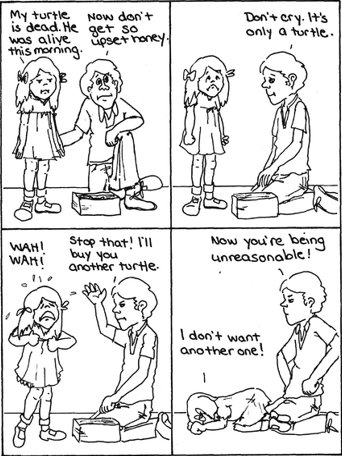
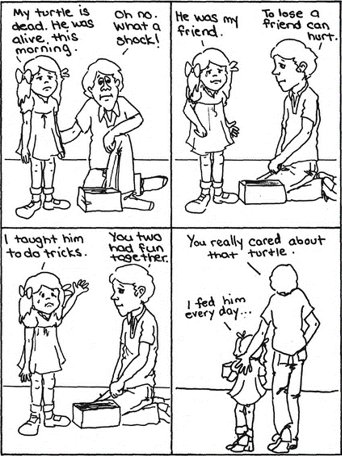
How to Empathize with Your Spouse, Not Fix the Problem
Exercise
Enter Your Spouse’s Reality
The goal of this exercise is not to change your partner’s reality but to enter into it.
Directions. One talking spouse shares a situation they are experiencing. For example:
My boss is ridiculously demanding.
The listening spouse then does the following.
- Use sounds and words such as mmm and I see, and body language (eye contact, nodding your head), to show your engagement.
- Think of a word that describes the emotion being expressed, such as frustration, and use it in a sentence to show your understanding.
It sounds like your boss is a real source of frustration for you.
Should you name the wrong emotion, no worries. Your spouse will correct you.
- Focus on that emotion (frustration) and ask follow-up questions such as:
Tell me more about what you’re feeling.
Have you felt this way before?
What other related emotions are you experiencing?
What sensations do you feel in your body?
What are you saying to yourself when you feel this way?
How may this experience impact you going forward?
- End by saying, “If I had the power…”
If I had the power, I would fire the man and bring back your old boss.
Take turns practicing this sequence until it feels more natural to you. Then use it in the extended story below.
An Extended Exercise
According to the book Who Walk Alone (1940), Ned Langford was an American who fought in the Spanish-American War in the Philippines in 1898. Nine years after he returned home, and just months before he was to marry Jane, Ned learned that he had contracted leprosy in the Philippines. After secretly seeing numerous doctors to diagnose and treat his condition, Ned went to a specialist in New York City and lived there for a year in isolation.
Other than his younger brother, Tom, no one knew of Ned’s condition. To spare his family and fiancée, Ned staged his suicide so others could get on with their lives. Soon after arriving in the city, he drove his car into the Hudson River at 2 a.m. He left enough papers behind for the police to identify the victim, who they assumed was carried away by the current. At the end of the year of fruitless treatment, Ned wrote this letter to his brother, which I have edited and shortened.
Instructions
Paragraphs 1–3: Partner A reads, Partner B reflects.
Paragraphs 4–6: Partner B reads, Partner A reflects.
After each paragraph, the listening partner reflects what was said, using the four steps in the exercise above. See how well you can empathize with each other in this moving story.
Tom,
I’ve reached the end. It’s insane for me to attempt to go on longer with this farce. I’ve clung in stupid desperation to the thought that I would grow better, that I must grow better. I’ve refused, hour by hour, to believe that such a thing could or was actually happening to me. For almost one year it has gone on just like that, hour by hour. Yes, minute following minute, every interminable waking minute trying to calm myself into believing that it wasn’t happening, that it couldn’t happen to me any more than it could happen to you, or mother, or Jane. Every foot of every block of the city streets that I have paced week in and week out, month in and month out, can testify to the prayers that I have breathed.
Partner B: reflect up to this point
But it has happened, Tom. Incredible as it is, it has happened to me. I’m a leper, a leper who for a solid year has been living in a fool’s paradise of make-believe, pretending that I would once more see home, and mother, and you at some time if not soon. Even that some time I would be going back to Jane and that she would not ask where I had been, or why. That together we would begin our life. That’s not going to happen, Tom.
Partner B: reflect

One time I took a steam boat that runs from Battery Park to Coney Island. I thought the going down the bay, the music and gaiety, the amusements at Coney would help me to forget for a few hours. They only made me remember all the more deeply. I spent the hour on the boat trying to avoid pressing against the crowd. My actions attracted attention and people looked at me suspiciously. I became confused and embarrassed. At last I found myself on the lower deck at the extreme stern of the boat. There I was alone except for a watchman who occasionally strolled past. Evidently he had grown suspicious, too, or some of the passengers had pointed me out. I was not far from jumping overboard then, Tom. The white, foamy wake of the ship a few feet below me looked warm and peaceful. You helped me then, kid, just as you have on other occasions. I remembered what you have asked repeatedly. You wrote once, remember: “Don’t ever just quit.”
Partner B: reflect
Switch speaker and listener roles

That same night when we landed at Coney Island I could do nothing. Every amusement meant crowding in with a lot of people. I made the attempt several times and each time had to step out of line. A nausea spread through my whole body. I went back to the boat and when I saw its brilliantly lighted deck, my knees went weak. I couldn’t face another agonizing hour on board. I turned back and, keeping in the shadow, crossed to where the lights grew few and although it was miles back to the city, I walked it. Walked and walked through that whole night. I walked, and thought, and suffered. You could never believe how alone aloneness is. You have to move, live, breathe, see, hear, in the midst of millions of people, not daring to touch one of them, afraid to speak lest they become friendly – avoiding – avoiding – eternally avoiding.
Partner A: reflect
I can’t endure another day of it. I’m going where there are others like me, where there will be thousands of us, where I need not hesitate to speak to the man I meet in the street. Where, if someone jostles me I don’t have to slink away from him like a beaten dog.
Partner A: reflect
Tomorrow I will be gone. Dr. Thompson is helping me get on an army transport from San Francisco that is headed for the Philippines. You can write me at the leper colony on Culion Island. I know nothing of the world into which I am going. When I am there, I shall write to you. Meanwhile, don’t think I’ve quit. I’ve just accepted what can’t be avoided – I’ve lost my life – I shall try to find it again.
Affectionately, Ned
Partner A: reflect
What Empathy Can Do for a Relationship
I conclude the chapter with a positive story of what empathy can do, not only for a relationship, but for the person receiving it.
The most understanding person in my life is my husband. He walked into my life in 2009, and every single day since, I am thankful for him….
I can be a hard person to be with at times. I am complex, and often contradictory. I can be emotional, impatient, and sometimes, though he wouldn’t admit it, I’m sure I can be frustrating. Whatever the situation, I can count on his understanding and empathy, 100% of the time.
My relationship with him has changed my life, in that, he has taught me much about self-awareness, spirituality, and kindness. He is always the voice of reason. Most importantly, after many bad experiences with people, he taught me to trust again.
Struggling in your marriage? There is hope.
Call Dr. Ken Newberger at 561-490-4991 to talk about your situation free of charge. Or, if you prefer, learn about his unique process.